
Introduction
Can crystallized DEF be removed from a Cat® Clean Emissions Module (CEM)? Or other emissions filters, for that matter? Yes, in most cases it can.
One local fleet learned this lesson the hard way. They had already replaced their CEM with a brand new unit that set them back around $8,600. Then they found out that a professional DPF cleaning could have fixed it. They brought the original DEF-clogged CEM to our DES Redding shop, and we were able to get it cleaned. Due to the amount of crystallization, it required three thermal cleanings that ended up costing $600 (normally one cleaning is enough).
The main idea here is that it’s often worth giving DPF cleaning a try before spending the big bucks on a new unit or filter. This could literally save you thousands. Seen enough? Get your DPF cleaned.
Quick Answer: Can Crystallized DEF Be Cleaned?
Most emissions units and filters with Diesel Exhaust Fluid (DEF) crystallization can be cleaned. Whether you can clean it depends on the unit’s type and condition, and the unit still has to pass a thorough inspection. A cracked filter brick or one with too many hard-packed cells can’t go back on a vehicle.
Cleaning also won’t address the original upstream issue. The doser or whatever else started the problem needs fixing too.
We’ll be covering why DEF crystallizes, what we found inside these two units, and how to decide between cleaning and replacing.

LET'S GET STARTED!
Why DEF Crystallizes in the First Place
DEF (a mixture of 32.5% urea and 67.5% deionized water) is sprayed into the exhaust ahead of the SCR, where it mixes to break down Nitrogen Oxides (NOx) into harmless nitrogen gas (N2) and water vapor (H2O), along with carbon dioxide (CO2) from the urea decomposition.
When the fluid doesn’t fully break down or mix, it can leave solid deposits (that can look like crystals) on the inside surfaces of the exhaust system. These deposits can restrict exhaust flow, raise backpressure, and reduce SCR performance, which can set NOx-related fault codes.
The usual contributors are low exhaust temperatures, a worn or misbehaving DEF injector (the doser), over-dosing from a pump or DEF injector fault, and poor-quality DEF, including DEF topped off with hard water. Our own techs’ list of possible causes starts with a doser malfunction, plus anything that lets outside air reach the DEF: a failed doser gasket, loose doser mounting bolts, or a compromised supply hose (a pinhole or a crack).
Case Study: What We Found Inside Two Cat® CEMs
A pair of Cat® CEMs came through our Redding shop recently from two local fleets, and each had a different problem.
The first came from a local lumber company. It was a Cat® 470-0239 Clean Emissions Module, an enclosed unit with thick, heavy, crystallized DEF inside.
We baked it in our Filtertherm Thermal Cleaning Oven three times due to the level of buildup and the enclosed nature of this unit. After the third cleaning, the crusty DEF was removed. The lumber company this came from had already bought a new unit by then, so the cleaned one is now a spare. If they had called us first, they could have saved about $8,000 in this example. That’s some real money.
The second unit came from an equipment rental company in the area. It had coolant inside and was heavily soot-loaded. We ran it through a drying cycle first to remove the coolant, then gave it a standard thermal cleaning overnight. This unit is “sealed”, so we aren’t able to see inside certain areas, and the coolant likely poisoned the DOC. The owner ended up ordering a very expensive replacement CEM from overseas, and while they wait, the cleaned unit may help keep the machine working until it arrives.
Two different outcomes. The DEF-clogged unit was restored for far less than the cost of a new one. The coolant-contaminated unit was a stopgap: its owner still needed a replacement, but the cleaning may buy them some time.

Cleaning vs. Replacing: See the Savings
| Options: | Costs: | Notes: |
| New Cat® CEM (470-0239) | Over $8,600* | Dealer list price (at time of publication) |
| Thermal cleaning (three rounds) | $600** | $300 for the first cleaning, $150 for each additional |
| Potential Savings | About $8,000 | List price minus the three cleanings this unit needed |
*List price isn’t always what a fleet pays, and a cleaned unit must pass inspection before it goes back on a machine.
** Usually, one cleaning is enough. The final cost of cleaning depends on how heavy the buildup is, which can lead to additional bake passes.
When Cleaning Isn’t an Option
Cleaning only works on a unit that is still sound. A cracked or otherwise compromised filter shouldn’t be cleaned or put back on a vehicle. The same goes for a filter with too many hard-packed cells preventing proper airflow to meet specs. That’s why it’s so important to do a visual inspection and a pin test (a welding rod is inserted into various cells at regular intervals to see how full they are and determine if there’s any hard-packed soot).
For standard-shaped filters, we weigh and flow test before and after every cleaning to measure and demonstrate the effectiveness of the process. CEMs like this one are welded shut, so a borescope inspection and a before-and-after weight are the standard methods of measurement.
Coolant is another limiter. Coolant that gets into a CEM, such as from an upstream engine failure, may “poison” the coating on the DOC, and no amount of cleaning will fix that (generally, coolant and other engine fluids can be removed from the DPF and SCR using thermal cleaning).
SIDE BAR
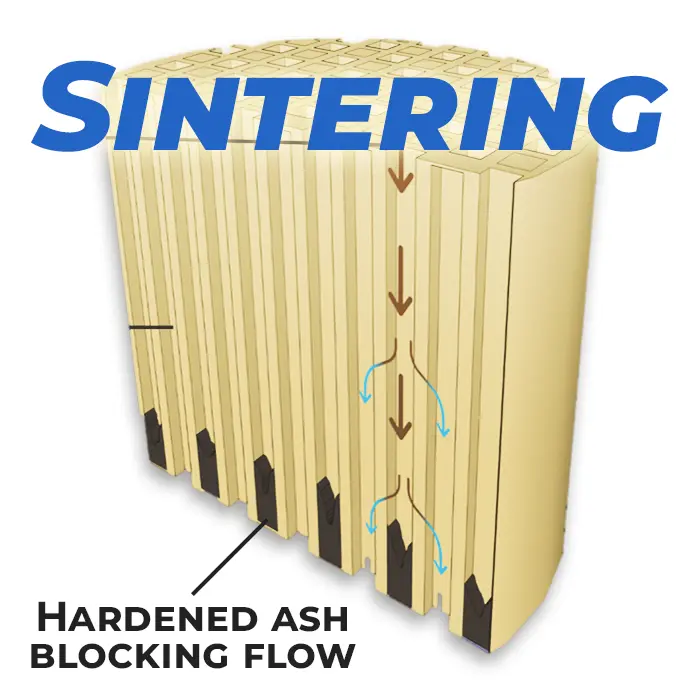
Sintering – The Silent DPF Killer: Unseen within the filter, ash can build up and sometimes harden into a cement-like substance called “hard ash sintering”. This generally can’t be undone, reduces DPF efficiency & will lead to a filter replacement. Frequent & properly performed DPF cleaning helps prevent sintering as does good upstream maintenance.
Common Sense: Fix the Cause First
Cleaning removes the buildup. It doesn’t touch what caused it. Before a cleaned unit goes back on a machine, have the dosing side checked: the doser, its gasket and mounting bolts, the supply hose (look for pinholes and cracks), the DEF pump, and the quality of the DEF in the tank. Any fault codes tied to dosing should be sorted out too.
The same goes for a unit contaminated with coolant or oil: the upstream problem must be repaired, or the contamination will just come back.
Low exhaust temperatures are another contributor to excess soot buildup, so a truck that rarely gets up to temperature from heavy idling is worth discussing with your service provider. To determine if cleaning should be done more often than usual or if more forced regens might be helpful.
Before You Order a Replacement
DES Redding offers professional, industrial thermal cleaning for DPFs, DOCs, SCRs, and aftertreatment units, including One Boxes. If you have a clogged DPF, CEM, or other aftertreatment unit, call us before you order a new one and ask whether yours is a candidate for cleaning.
See our DPF cleaning services or call DES Redding at 530-241-3950.
We also offer full-service DPF Cleaning at our Sacramento and Portland locations

Q: Can crystallized DEF be cleaned out of an emissions unit?
A: Often, yes. A heavy buildup may take more than one thermal cleaning, and the unit has to pass inspection afterward.
Q: What causes DEF crystallization?
A: Crystals form when DEF doesn’t fully break down or mix before it reaches the surfaces inside the exhaust system. Common contributors are a doser malfunction, anything that lets outside air reach the DEF (a failed doser gasket, loose mounting bolts, a cracked or pin-holed supply hose), low exhaust temperatures, and poor-quality DEF.
Q: What are the signs of DEF crystallization?
A: Common signs include SCR or NOx-related fault codes, reduced NOx conversion, a derate, and a white, crusty buildup around the doser mounting point. Heavy deposits inside a sealed unit can also raise exhaust backpressure, but they can’t be seen from the outside, so an inspection is how you confirm them.
Q: Can a CEM with coolant and soot loading be cleaned?
A: Partly. In one recent case, a heavily soot-loaded unit with coolant inside, caused by an upstream engine issue, was run through a dry-out cycle and then given a single thermal cleaning. Because the unit is sealed, we couldn’t see inside, and the coolant likely poisoned the DOC, so the owner still ordered a replacement. The cleaned unit may keep the machine running until it arrives.
Q: Does this apply to on-road truck aftertreatment systems?
A: Yes. These two off-road Cat® units are unusual for us, since most of our cleaning is on-road truck DPFs and aftertreatment systems. The same principles apply to DEF crystallization and to coolant poisoning the DOC, and the same inspection limits apply.
Q: How do I know if a unit is a candidate for cleaning?
A: It has to be structurally sound. A cracked or otherwise compromised filter shouldn’t be cleaned or reinstalled, and neither should one with too many hard-packed cells. Standard filters get weighed and flow tested before and after every cleaning. Welded-shut units like CEMs get a borescope inspection and a before-and-after weigh instead.
Q: Does cleaning fix whatever caused the buildup?
A: No. Have the doser, its gasket and mounting bolts, the supply hose and the DEF quality checked before the unit goes back into service. For a unit contaminated with coolant, the upstream engine problem needs repair too.
Q: How can I prevent DEF crystallization?
A: Use clean, fresh DEF, keep the dosing system sealed and in good repair, and deal with dosing fault codes early. Low exhaust temperatures also contribute, so a truck that mostly makes short trips or runs at low load is worth discussing with your service provider.

Diesel Emissions Services (DES) has the expertise, equipment, techs, and facilities to service your aftertreatment system.
Most of our locations feature a professional DPF Cleaning, aftertreatment diagnostics, Clean Truck Tests, and a full inventory of aftertreatment parts for your emissions system.
Sources:
- Investigation of Urea Derived Deposits Composition in SCR Systems (SAE 2016-01-2327)
- Tier 4 Final DEF Systems: Preventing Crystallization and SCR Failures
- Analytical Investigation of Urea Deposits in SCR System (SAE 2015-01-1037)
- DEF System Problems: Causes, Troubleshooting & Fixes
- Reductant Injector (YOUCANIC glossary)
We hope you found this article helpful. At DES, we believe in putting out educational and informative content to not only our customers but for the general industry to grow and benefit from.
To share this article, use one of the social media icons above.